
When local businesses need IT or cybersecurity services, they don’t flip through phone books or wait for cold calls. They turn to Google and search for things like ‘IT support near me’ or ‘MSP in [City Name].’ That’s where effective local SEO for MSPs makes all the difference. If your company doesn’t appear in those results, your competitors will — and they’ll be the ones who get the call.
Prioritizing local SEO can address this problem by helping your business appear when nearby companies actively search for services like yours. Local SEO is a proven strategy that helps MSPs dominate Google Maps rankings, increase local visibility, and build lasting relationships with area businesses.
This article reveals the exact strategies that work, designed specifically for MSPs who want practical results without technical complexity.
Why Local SEO Is Non-Negotiable for MSPs
Local businesses prefer working with nearby MSPs for good reason. When dealing with sensitive data and critical systems, proximity matters. They often want to meet their IT team face-to-face, visit offices, and establish trust before handing over their digital infrastructure.
The numbers tell the story:
- Approximately 46% of Google searches are seeking something local, such as a nearby business or service.
- 88% of local business searches lead to a call or store visit within 24 hours.
- Businesses in the local pack enjoy an 80% higher click-through rate
This represents a massive opportunity. 94% of high-performing brands have a dedicated local marketing strategy, compared to 60% of average performers. While large national MSPs compete heavily for enterprise clients, local markets often remain underserved. Smart MSPs can capture significant market share through focused local marketing strategies.
3 Critical Mistakes Many MSPs Make
- Unclaimed Google Business Profile → Misses map pack visibility entirely
- No location-specific content → Can’t rank for city-based searches
- Inconsistent business listings → Hurts local search credibility
Avoiding these mistakes puts you ahead of most competitors immediately.

Step 1: Master Your Google Business Profile
MSP Google My Business optimization serves as your digital storefront and the foundation of local search success. Your Google Business Profile often provides the first impression potential clients receive of your MSP.
Perfect Your Business Information
Start with your business name. Instead of just “AlphaTech Solutions,” use “Boston Managed IT Services | AlphaTech.” This approach includes your core service and city for better keyword matching.
Ensure your Name, Address, and Phone number (NAP) remains identical across all platforms. Even minor variations can confuse search algorithms and hurt your rankings.
Select strategic categories:
- Primary: Computer Support and Services
Secondary: IT Support Company, Cloud Computing Service, Computer Security Service
Create Compelling Content
Write a business description that speaks directly to local concerns:
“We help [City] businesses prevent costly downtime with 24/7 managed IT support, cybersecurity protection, and compliance solutions. Serving [City] and surrounding areas since 2010.”
Post regular updates that provide value:
- Offers: “Free Network Assessment for [City] Businesses”
- Events: “Cybersecurity Workshop at [Local Co-Working Space]”
Case Studies: “How We Saved [Local Business] From a $50k Ransomware Attack”
Review Generation System
Automate review requests after completing service tickets. Use this proven email template:
Subject: How was your recent IT support experience?
Hi [Name],
We’d love your feedback about our recent [service performed].
Could you take 30 seconds to leave a review? [Link]
Your review helps other [City] businesses find reliable IT support.
Thanks, [Your Name]83–88% of consumers use Google to view local business reviews before visiting.
Step 2: Build Location-Specific Website Pages
MSP local search optimization requires dedicated pages for each service area. These pages demonstrate your local presence while targeting geographic search terms.
Local Service Page Template
Title Tag: Managed IT Services in [City] | [Your MSP Name]
Content Structure:
- Local Social Proof
- “Trusted by [X] businesses in [City]”
- Display client logos from the area
- Service-Specific Content
- “Cloud Migration Support for [City] Healthcare Offices”
- “Network Security for [City] Financial Firms”
- Local Challenges
- Address specific technology concerns affecting area businesses
- Mention local compliance requirements or industry concentrations
- Contact Information
- Embed Google Map showing your office location
- Include local phone number and service area details
Content That Connects Locally
Create blog content addressing local business concerns. For example:
- “Top 5 IT Challenges for Small Businesses in Vancouver”
- “How to Protect Remote Workers in Calgary from Cyber Threats”
- “What Managed IT Services Cost in Ontario: 2024 Pricing Guide”
Each piece should use location keywords naturally while solving real problems. This approach helps your MSP appear earlier in the buyer journey, before competitors make contact.
Step 3: Dominate Local Directory Listings
Strategic MSP local directory listings establish credibility across multiple platforms while improving search visibility. This comprehensive presence signals to search engines that your MSP legitimately serves specific geographic areas.
Essential Directory Submissions
Major Platforms: Google, Bing Places, Apple Maps, Yelp Industry-Specific: IT service directories, chamber of commerce listings Local Options: City business directories, regional business journals.
Consistency Is Key
Maintain exact NAP (Name, Address, Phone) consistency across all listings. Create a master spreadsheet tracking every submission to ensure updates remain synchronized when business information changes.
Write service descriptions using language that resonates with business owners rather than technical terminology. Instead of “comprehensive network infrastructure management,” use “keeping your business computers and internet running smoothly.”
Building Local Authority
Secure local backlinks through:
- Chamber of Commerce membership and profile
- Local business partnerships with office equipment suppliers or commercial real estate firms
- Community involvement in business associations and networking groups
These connections build genuine local authority while creating natural link opportunities.
Step 4: Convert Local Traffic Into Clients
Effective local lead generation requires optimizing the entire conversion path from search to signed contract.
Landing Page Optimization
Create compelling offers specifically for local audiences:
- “Free Network Security Assessment for [City] Businesses”
- “Complimentary IT Consultation for [Industry] Companies in [Area]”
Design contact forms with qualifying questions:
- Number of employees
- Current IT challenges
- Decision-making timeline
- Budget expectations
Local Search Advertising
Complement organic efforts with targeted Google Ads using location-based keywords. This dual approach ensures maximum visibility while organic rankings develop.
Focus ad spending on high-intent searches like:
- “[City] managed IT Services”
- “IT support company near me”
- “[Industry] MSP [City]”
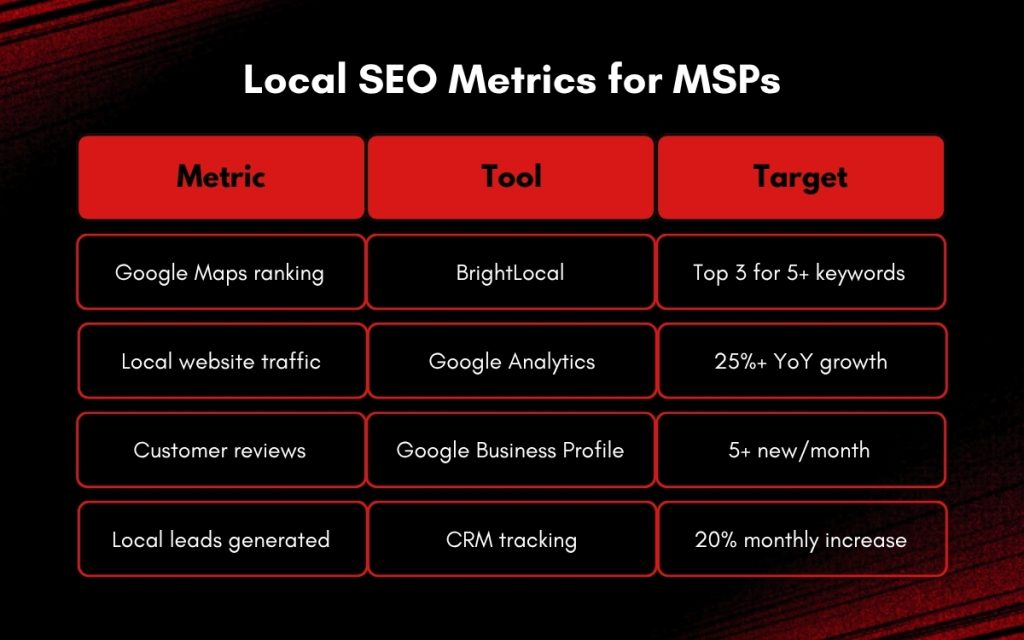
Track What Matters
Don’t just track traffic—measure actual business growth and client acquisition from local search efforts
Your 30-Day Local SEO Action Plan
Week 1: Foundation Setup
- Claim and optimize Google Business Profile
- Audit current directory listings for NAP consistency
- Set up Google Analytics and Search Console tracking
Week 2: Content Creation
- Build location-specific service pages for top 2 service areas
- Write first local business-focused blog post
- Create review generation email templates
Week 3: Directory Expansion
- Submit to 10 high-quality local directories
- Join local chamber of commerce or business association
- Reach out to 5 potential local business partners
Week 4: Review and Optimization
- Request reviews from recent satisfied clients
- Analyze first month’s performance data
- Plan next month’s content and optimization priorities
Measuring Long-Term Success
Local SEO builds momentum over time. Early efforts may produce modest results, but consistent implementation creates compound benefits that become increasingly difficult for competitors to overcome.
Track these indicators of growing local authority:
- Search Visibility: Rankings for location + service keywords
- Business Profile Performance: Views, clicks, calls, and direction requests
- Website Engagement: Local traffic growth and time spent on location pages
- Lead Quality: Percentage of local inquiries that become clients
Successful MSPs typically see significant improvements within 3-6 months, with continued growth as local authority strengthens.
Getting Professional Help
Many successful MSPs partner with specialized marketing agencies when internal resources limit implementation consistency. Consider professional assistance if:
- Your team lacks time for consistent content creation
- Technical SEO requirements exceed internal capabilities
- Local competition requires more aggressive optimization strategies
The key is maintaining focus on core MSP services while ensuring local visibility grows steadily.
Your Path to Local Market Dominance
Local SEO for MSPs isn’t just another marketing tactic. It’s essential for sustainable growth in competitive technology markets.
While National Providers Compete Heavily for Enterprise Accounts, Local Markets Often Remain Underserved and Represent Significant Opportunities.
The strategies in this article work because they focus on genuine value creation. With effective local SEO for MSPs, you’re not just chasing rankings — you’re helping nearby businesses find the services they actually need. By optimizing your Google Business Profile, creating location-specific content, and building local authority, you’re not gaming the system—you’re making it easier for businesses that need your services to find you.
Local businesses desperately need reliable MSP services. Your technical expertise deserves to be discovered when they search online. Start implementing these strategies immediately, focusing on consistency over perfection.
Remember: the companies that win are the ones that show up first, provide real value, and make it easy for local clients to say “yes.” Your local market dominance begins with the first step you take today. Ready to dominate your local market? The businesses in your area are searching for MSP services right now. Make sure they find you first. Contact us today for a free consultation.