Fear, uncertainty, and doubt—commonly known as FUD—have long been staples in cybersecurity marketing. Breach headlines. Regulatory panic. Catastrophe-driven CTAs. The idea: scare buyers into acting fast. But is using fear in marketing cybersecurity solutions a good strategy in 2025?
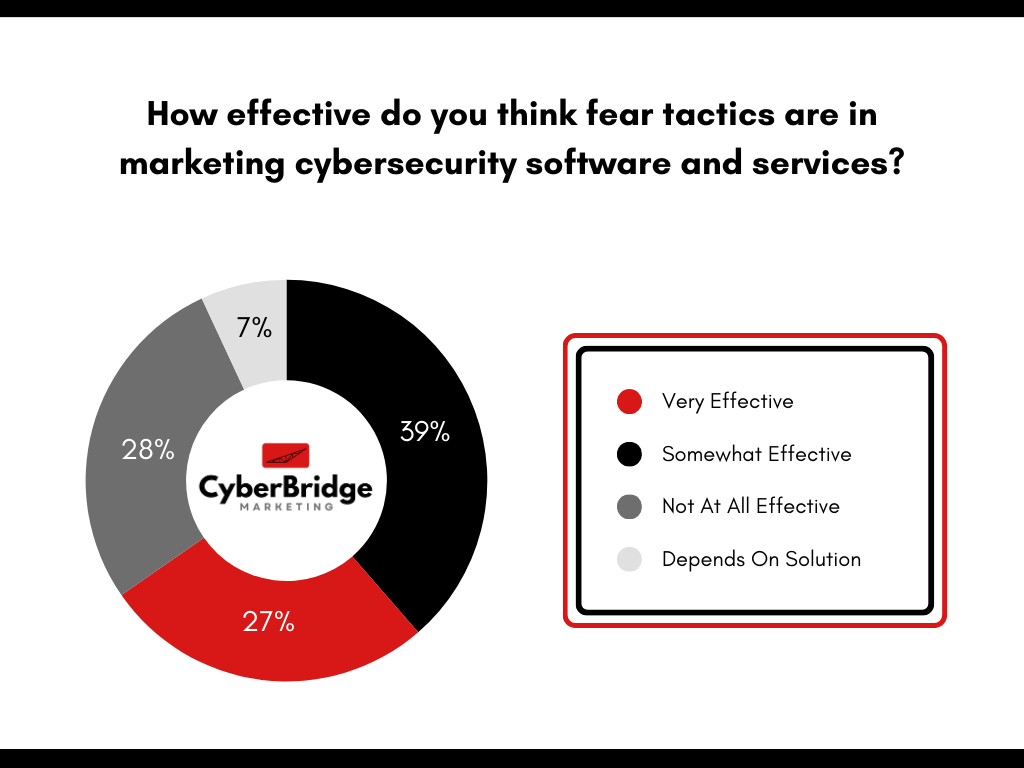
We surveyed cybersecurity professionals and asked: “How effective do you think fear tactics are in marketing cybersecurity software and services?”. 39% said somewhat effective, 28% said not at all effective, and 27% said very effective. That kind of distribution tells us one thing: the effectiveness of fear in marketing cybersecurity solutions is under serious scrutiny. To dig deeper, we spoke with respected voices in the cybersecurity space to get their take.
Data Doesn’t Lie. Most Buyers Tune Out Fear.
Jay McBain, Chief Analyst at Canalys, points to hard numbers that paint a very telling picture. With so much competition, standing out is critical. Leading with fear is no longer a strategy. It is a risk.
“Studies show that fear tactics are only successful with 25% to 29% of recipients,” said McBain. “In an industry that has 6,500 vendors who have primarily used threatening marketing tactics are perhaps missing two-thirds to three-quarters of their market TAM.”

FUD Doesn’t Sell to Cyber Savvy Buyers.
Wil Klusovsky, cybersecurity and tech business advisor, believes fear tactics are outdated and counterproductive.
“In my experience, FUD doesn’t sell. It’s an antiquated approach that mature companies won’t use and educated buyers will ignore,” said Klusovsky. “I’m not saying that using current events, regulations, or incidents can’t bring value, but that value should come in the form of education. For example, ‘Here’s what happened, why it worked, and what you can do about it.’”

His take aligns with the modern shift toward trust-based marketing, where value, insight, and partnership win over panic-driven urgency.
“Marketing in cybersecurity and tech needs to educate and engage, not scare,” Klusovsky added. “Scaring your client into a purchase is not a way to show true partnership or trusted advisor status. It says ‘I’m here for a transaction’.”
Fear Might Work Fast, But It Doesn’t Last.
Matthew Rosenquist, CISO and Cybersecurity Strategist at Mercury Risk and Compliance, cautions that while FUD can drive quick results, it erodes long-term credibility.
“The use of FUD as a mechanism for cybersecurity funding justification is a shortsighted tactic,” said Rosenquist. “Tapping into human behaviors for urgency and potential catastrophe is powerful at first. It often works for immediate financial relief, but as time goes on and the audience becomes savvier, it makes the leader or vendor look less credible and more of a fear monger looking for a shortcut.”

Rosenquist notes that over-reliance on fear often ends with leadership turnover or vendor abandonment. The takeaway? Trust is harder to earn back than attention is to gain.
“It can come to a crescendo, when vast money has been invested without justifiable data, and failures still occur. This is often when vendors are abandoned or CISOs who use this method exit and move to another organization,” added Rosenquist. “FUD remains far too common as an approach, but it undermines trust in the cybersecurity organization and the industry as a whole.”
FUD Works Best with Less Experienced Buyers.
Ken Yao, Founder at Cyberse, reinforced the idea that using fear in marketing cybersecurity solutions are not useful for more experienced buyers, but may have a place for buyers not heavily experienced in cybersecurity.
“Fear-based marketing tends to work better with small and mid-sized businesses, where buyers may have less experience. On the other hand, more experienced enterprise buyers are usually turned off by that kind of messaging, so larger companies focus on a more thoughtful, value-driven approach instead,” said Yao.

Why Fear In Marketing Cybersecurity Solutions Falls Flat.
For years, using fear in marketing cybersecurity solutions was the dominant approach. But, times are changing. Today, fear-based campaigns often come across as manipulative or out of touch, especially when overused.
Psychologically, this makes sense. The self-positivity bias suggests that people tend to believe bad things happen to others, not themselves. So instead of triggering action, fear-based marketing can trigger skepticism. We discuss this further in our article “Psychology in Cybersecurity Marketing: How to Build Trust and Stand Out“.
Brands that lead with value, not fear, are more likely to earn trust and build long-term customer relationships. Instead of focusing on risks, highlight the rewards of strong cybersecurity. Think peace of mind, business continuity, and a sense of control.
What to Do Instead
If your brand is still relying on fear-based messaging, it might be time to rethink your approach. Here is where to start:
- Educate, not alarm. Use incidents as teaching moments, not scare tactics.
- Build trust, not urgency. Position your brand as a strategic advisor, not a quick fix.
- Tailor by audience maturity. Speak differently to SMBs than to enterprise buyers.
- Focus on outcomes. Emphasize what clients gain, not just what they avoid. Think peace of mind, business continuity, and a sense of control.
Not sure if your brand is sending the right message? Let’s fix that. Schedule a free consultation and uncover the messaging that sets you apart.
Let’s Work Together
Ready to grow your business? Let’s bridge the gap between your expertise and your ideal clients.